
How Frequently Should You Switch a Property Investment?
Switching from one property investment to another can be a strategic move — but only when done for the right reasons and at the right time.
Before making the leap, it’s crucial to evaluate the financial, tax, and market implications of exiting your current property investment and moving to another.

🔄 Why Do Investors Switch Property Investments?
There are typically two key reasons why people decide to switch or exit from a property investment:
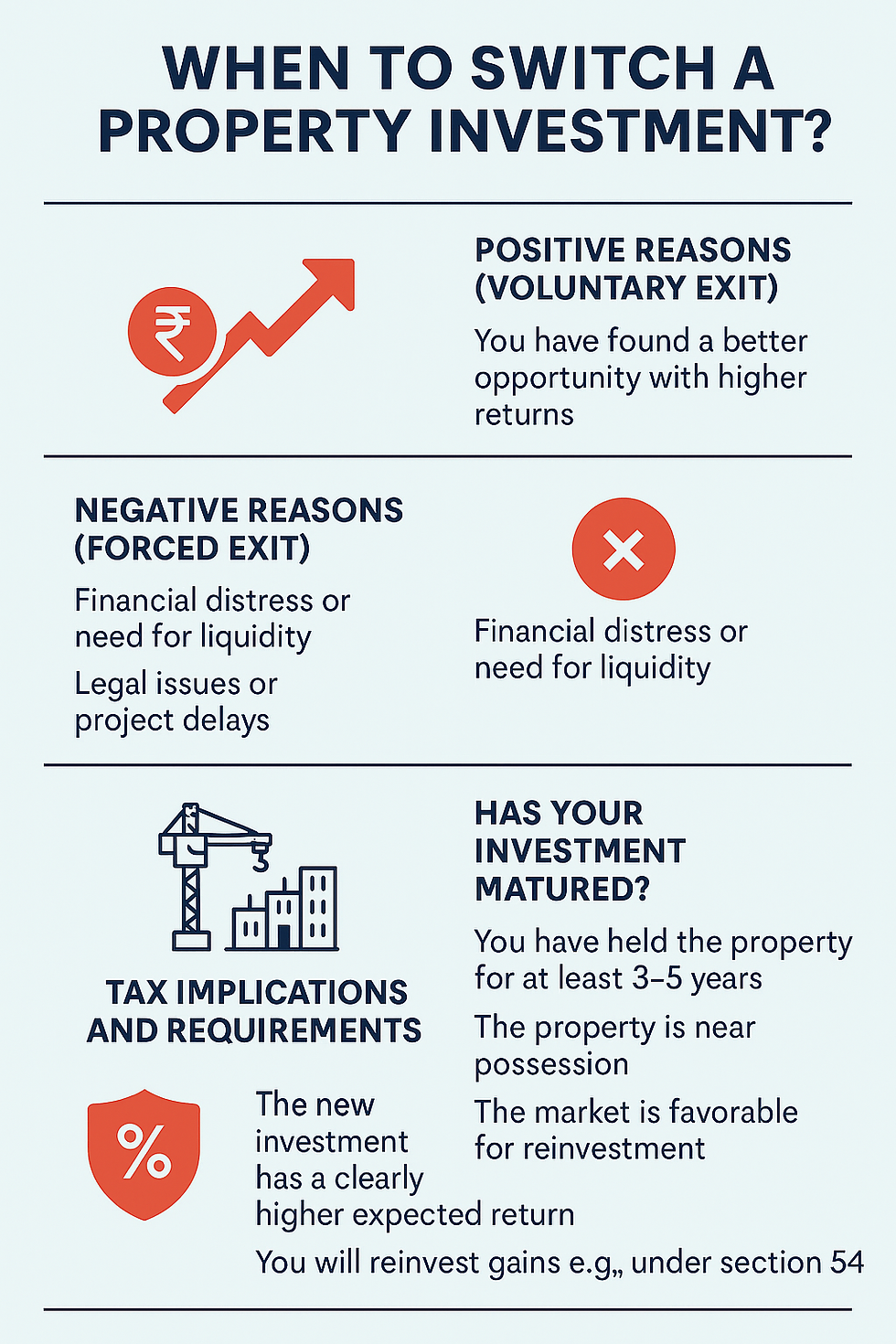
✅ Positive Reasons (Voluntary Exit)
● The investor has identified a better opportunity that offers higher returns.
● The market conditions are favorable, allowing for maximum profit realization.
❌ Negative Reasons (Forced Exit)
● Financial distress or need for liquidity.
● Legal issues, delays in possession, or unfavorable project developments.
📉 When Do Most Investors Exit?
Many investors enter at the pre-launch or early construction stage and exit once:
● The project is nearing possession,
● The developer starts giving out occupancy,
● Or the property sees its first wave of end-user movement.
This full cycle allows investors to maximize appreciation from pre-launch pricing to near-completion market value.
⏳ Is Real Estate a Short-Term Investment?
No. Property should not be treated like a short-term stock trade.
Experts suggest a minimum investment horizon of 3 to 5 years, especially when market conditions are uncertain.
This longer view:
● Helps reduce tax burdens,
● Offers the potential for higher appreciation,
● And gives the property time to mature in value.
💸 Tax Implications of Switching Investments
Here's what happens when you sell a property:
Holding Period | Tax Type | Tax Rate |
Less than 3 years | Short-Term Capital Gains (STCG) | Taxed as per income slab |
More than 3 years | Long-Term Capital Gains (LTCG) | 20% with indexation benefit |
👉 Tip: Selling within 3 years may seem beneficial due to quick liquidity, but can result in higher taxes due to income slab rates.

📊 When Is the Right Time to Switch?
You should consider switching your investment if:
● The new opportunity has a higher expected return than the current one.
● The property market is entering a bullish phase, and you're positioned to reinvest wisely.
● You're reinvesting the gains to avoid capital gains tax under sections like 54, 54F (residential reinvestments).
📌 Caution: Avoid switching just based on peer influence or temporary market noise. Analyze thoroughly.
🧠 Be a Smart Investor
A savvy investor always:
● Tracks market cycles and upcoming projects,
● Times their exit based on profitability and tax efficiency,
● And never jumps ship unless the next investment clearly outweighs the current one.
✅ Conclusion
Switching a property investment only makes sense if the alternative offers superior returns and supports your long-term financial goals.
If the gains don’t significantly exceed the cost of switching — including taxes, transaction fees, and market risk — it’s better to hold.
🔁 Switch when it makes sense — not just because you can!


Comments